
Scarless
Lower Blepharoplasty
Lower Eyelid Rejuvenation
Surgery from the Inside Out
Transconjunctival lower blepharoplasty is the technical name for what is commonly known as scarless lower eyelid surgery. Rather than cutting through the skin, this approach accesses the fat pads responsible for under-eye puffiness through the inner lining of the lower eyelid, leaving no visible external incision.
The benefit isn’t purely cosmetic. The traditional external approach requires cutting through both skin and muscle, which can compromise the structural support of the lower eyelid over time, increasing the risk of lid retraction or malposition. The transconjunctival approach sidesteps this by leaving the outer layers undisturbed.
There are situations where an external incision is the right choice, and it can be performed safely when needed. It does, however, typically require additional steps to protect lid position and maintain support. The guiding principle of lower eyelid surgery is to accomplish the goal with the least disruption to its natural anatomy. Fortunately, for the majority of patients seeking correction of under-eye puffiness or hollowness, excellent results are achievable without affecting the skin.
No External Scar
The incision is hidden entirely inside the inner eyelid. There is nothing to see from the outside.
Preserved Anatomy
Surgeon experience, along with published research, consistently shows the transconjunctival approach carries a lower risk of lower lid retraction compared to external techniques.
Return To Normalcy
Without an external incision there is less lymphatic disruption and reduced visible cues that work has been done, leading to a quicker return to normalcy and incognito after surgery.
Who is this procedure for?
Two words come up in consultation more than any others: puffy and hollow. How do you see your eyes?
The lower lids are a game of contours. Puffy eye bags can be the defining feature — but those same bags often create the valley that causes the hollowing beneath them. Not always, but often enough that the two go together.
Transconjunctival lower blepharoplasty is the ideal way to address the contours of the lower lid complex. It reaches the fat responsible for the puffiness from inside the eyelid, without disrupting the outer layers, which leaves the surrounding anatomy free to be shaped or restored.
Comprehensive Approach
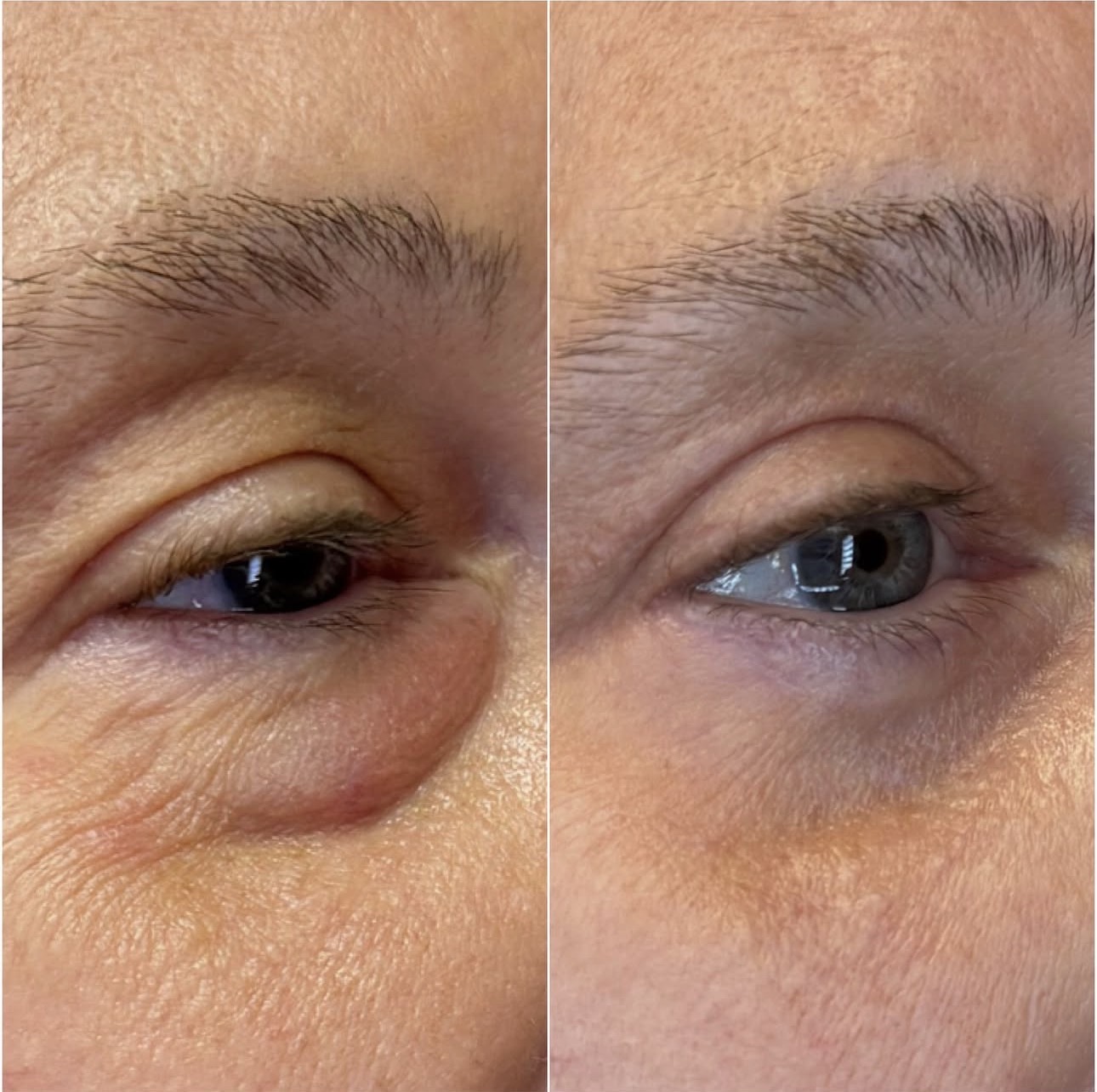
The lower eyelid shares tight real estate with the cheek. Puffy and hollow features often cannot be addressed by dealing with fat herniation alone. Sometimes skin needs attention. Sometimes the answer is adding cheek volume, or augmenting the lid-cheek transition to support the lower eyelid, improve hollowing, or even prevent hollowing after the procedure. Laser resurfacing is another effective tool for loose or crepey skin in this area.
Hollowing along the tear trough and orbital rim is addressed by restoring or redistributing volume — using the body’s own fat.
Fat Grafting
Fat harvested from a small donor site is placed along the tear trough and orbital rim, replacing lost volume with your own tissue. Results are long-lasting and age naturally.
Learn More →Fat Transposition
Rather than removing prolapsed fat, it is repositioned into the tear trough hollow below — addressing the bag and the depression simultaneously with existing tissue.
Learn More →Crepey texture and excess skin are addressed separately from fat. These options are layered in when the anatomy calls for them.
Laser Resurfacing
Laser improves the texture and tone of lower eyelid skin without an incision. Effective for crepiness and fine surface irregularities. Frequently the only additional step needed alongside fat work.
Skin Pinch
A conservative skin excision removes a small amount of excess lower eyelid skin through a precise external incision. Reserved for cases where skin laxity cannot be adequately addressed by laser alone.
FAQ — Scarless Blepharoplasty
Transconjunctival is the word that describes the placement of the incision. It means going “through-the-conjunctiva” – the inner lining of the eyelid. This enables approaching the herniated fat pads through the inner eyelid without making a visible incision.
Most people with puffy bags, or some degree of hollowing accentuated by eye bags, are candidates for this approach. Even if further work is required to address other parts of the eye, the puffy bags can often be addressed through this type of hidden incision.
Sub-ciliary refers to placing the incision under the ciliary margin, also known as the eyelash line. This is an external incision through the skin and muscle to approach the fat pads. The transconjunctival approach is made internally and does not require disrupting the skin and muscle layer to reach the fat pads.
Volume augmentation is frequently done alongside lower blepharoplasty to address hollowing, or to get ahead of potential hollowing after the procedure. Puffy or hollow lower eyes often go hand in hand with a volume deficiency at the lid-cheek junction, and some degree of additive restoration to the surrounding anatomy produces a more natural-looking result. This is usually done with fat grafting, and sometimes fat repositioning.
Lower lid retraction means a downward descent of the eyelid from its natural position. This can happen in any eyelid surgery, but its incidence is extensively minimized with the transconjunctival approach. Avoiding an external incision through skin and muscle prevents the potential for a downward contracture force on the eyelid. Dr. Hashemi has performed a large volume of eyelid surgeries and concurs with the well-studied literature that eyelid retraction in transconjunctival blepharoplasty is substantially lower than with an external incision.
Pain is not a word patients use with this procedure with any meaningful frequency. In terms of visible healing, there is scattered purple and mostly yellow bruising around the lower lid by week one when scarless blepharoplasty is done alone. Much of this is improved by week two, and by week three there is almost no evidence of recent surgery. Bruising and swelling vary by individual and by the amount of work done. When combined with fat grafting, repositioning, or laser, there can be more visible bruising in the first one-to-two weeks, though usually mild. Cold compresses, head elevation, and activity restrictions are part of the standard post-operative protocol. Most patients are ready to put on sunglasses by day three-to-five and are out running errands.
Absolutely. This is a very common combination. Upper blepharoplasty and lower blepharoplasty are frequently performed together in a single operation, meaning one anesthesia and one recovery period. No bridges are burned if you choose not to do the upper at the same time as the lower. It can always be done in the office under local anesthesia at a separate time.
The goal of this surgery is to improve the components of the lower eyelid that matter to you. This is done with a thoughtful, intentional plan that addresses areas of concern in a manner that preserves your anatomy with minimal trauma, without adding unnecessary treatments or procedures that could further alter the appearance of the lid. This includes minimally invasive incisions, judicious removal of fat, supporting the lower lid when necessary, and augmenting volume where needed. The goal is to restore the rested, rejuvenated, and alert appearance of the under eyes that preserves your natural essence.
More blepharoplasty options
Scarless lower blepharoplasty is one approach within a broader periorbital practice. Many patients benefit from addressing multiple concerns in a single operation.
Upper Blepharoplasty
Removal of excess upper eyelid skin and fat through a small incision hidden in the natural eyelid crease. Restores a more open, alert appearance to the upper eye.
About Lower Blepharoplasty
Comprehensive overview of the lower blepharoplasty process — what it addresses, how it is performed, and what to expect from consultation through recovery.
Blepharoplasty Gallery
See real patient results from lower blepharoplasty, upper blepharoplasty, and combined cases with fat grafting.