
The rhinoplasty swelling timeline: week one to the one-year result
One of the most rewarding moments in my postoperative clinic happens at the one week visit. The cast comes off. The patient finally gets to see their nose. They are excited to see the changes that have been hidden underneath the cast. And then comes one of the most important parts of the conversation:
This is not your final nose.
What you see at one week is a nose that has just been through surgery. The underlying bone and cartilage have been reshaped, but the skin and soft tissues that cover that framework are still swollen and are still adapting to the new underlying structure.
A useful way to think about rhinoplasty is that the framework is changed during surgery, but the skin has to catch up afterward. The skin does not instantly shrink wrap itself around the new framework. It gradually settles, contracts, and adapts. Some areas do this quickly. Others can hold swelling for many months. That is why a rhinoplasty result is not revealed all at once. Some of the improvement is immediately apparent, while other details emerge gradually over the following months.
Understanding this timeline is important because patients, and surgeons, naturally want to see the final result as quickly as possible. The key is knowing what changes are expected at each stage and, just as importantly, what changes are not a reason for concern.
The First Week: Rhinoplasty Swelling Peaks, Then Starts to Fall
The first several days are when swelling is at its most noticeable.
For many patients, swelling peaks around postoperative day three or four and then begins to decrease relatively quickly. Nasal congestion can occur during this period because the swelling encroaches on the nasal airway as well.
The cast serves several purposes during this early period, including protecting the nose while the framework heals and providing a rigid barrier against swelling that would otherwise expand unchecked.
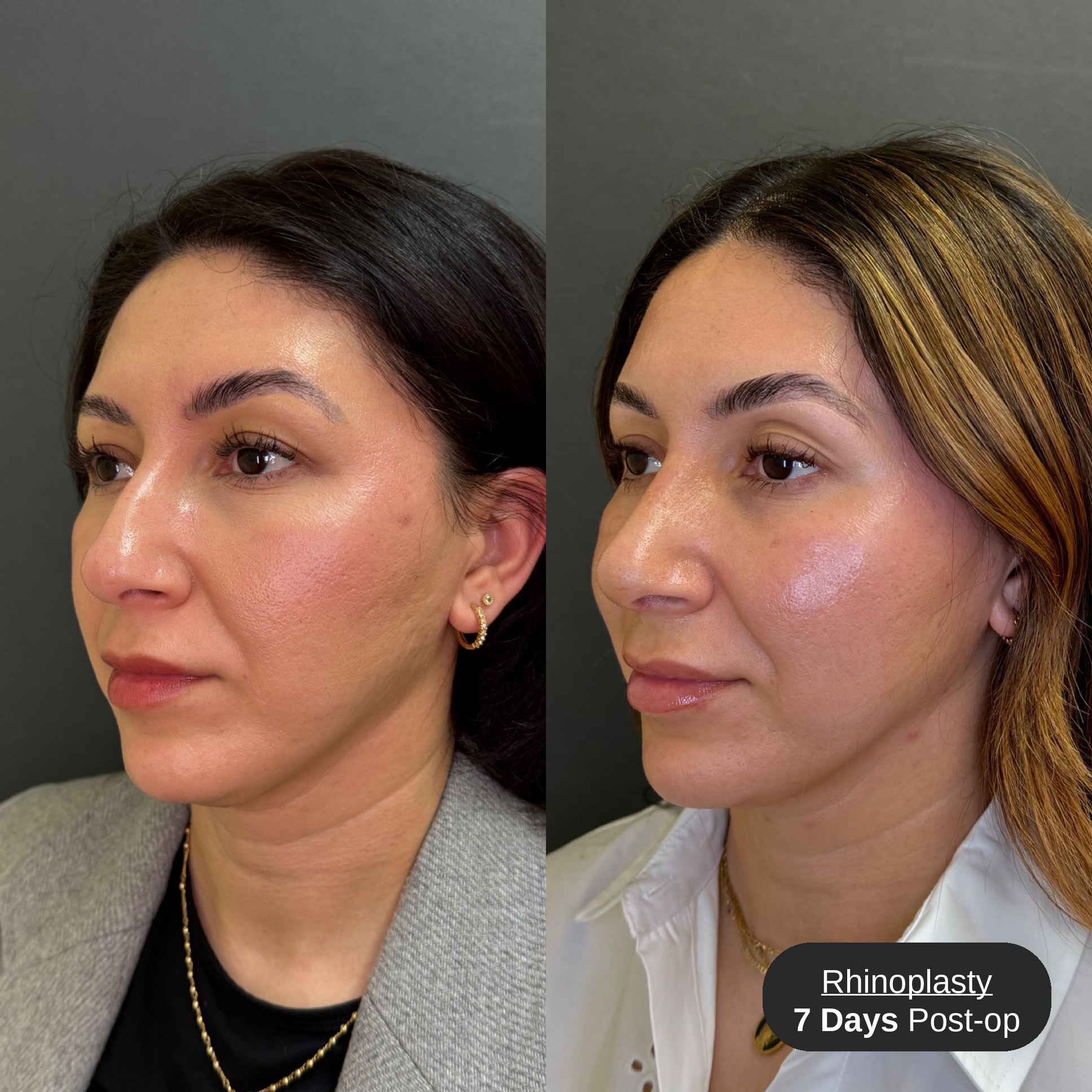
Bruising varies from person to person. It also depends on the surgical technique and the extent of the work performed. I perform ultrasonic, or piezoelectric, rhinoplasty, and many patients have relatively little visible bruising by the time they return for cast and suture removal. Most have only some mild yellowish discoloration.
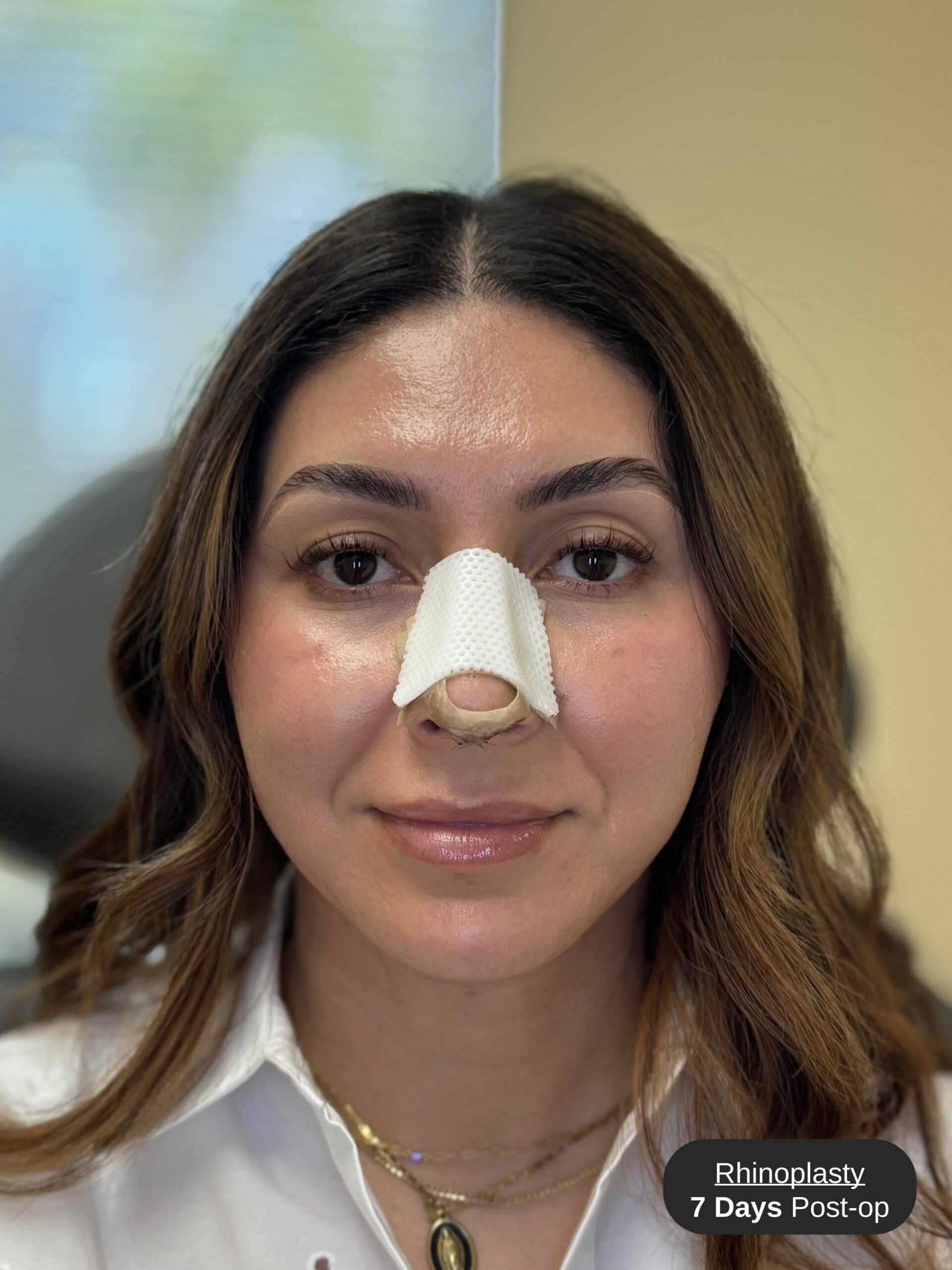
When the cast comes off, the nose can look surprisingly good. It can also look swollen, wide, stiff, or somewhat unfamiliar. All of these can be normal. The important point is that the shape you see at one week is a combination of the new underlying structure and the temporary swelling covering it.
Why I use taping
I typically have patients tape the nose continuously during the first week after the cast is removed and then at night for several additional weeks. The full protocol is outlined in my rhinoplasty planning and recovery guide. The tape is not physically forcing the nose into its final shape. Rather, it provides gentle external compression and support while the soft tissues continue to settle onto the new framework.
The exact duration of taping is individualized. Skin thickness, the amount and type of surgery performed, and the way a particular nose is healing all influence how I approach it. That said, I think there are downsides to over taping. The nasal skin is highly sebaceous, and this contributes to swelling, so tape can keep the skin oily and swollen. The repeated trauma of removing tape can also, at some point, work in the other direction and create abnormal nodules or swelling. Taping is safe overall. But these small details make a difference, so my taping advice is individualized, and we do not do things unless they make sense for your nose.
Weeks Two Through Six: The Fastest Visible Change
The second through sixth postoperative weeks are often when patients notice the most dramatic week to week changes. The nose gradually becomes smaller and more defined as swelling decreases.
Swelling is not uniform
One of the most important things to understand about rhinoplasty swelling is that it does not disappear evenly. Some portions of the nose have very thin skin sitting directly over relatively rigid structures, such as the nasal bones. These areas often reveal their final contours earlier because there is relatively little soft tissue and dead space for swelling to occupy.
Other areas hold swelling longer, particularly the nasal tip and the supratip, which is the area just above the tip where the bridge transitions into it. These regions have thicker soft tissue and sit over more compressible cartilage, so they can remain swollen considerably longer.
This is one reason the bridge may look refined relatively early while the tip still looks somewhat round or under defined.
Swelling can also be asymmetric. One side of the nose may look slightly fuller than the other. This can happen from side sleeping. It can happen from different work, grafts, or sutures used during surgery on one side versus the other. The tip may appear a little off center on one day and more symmetric on another. A patient may notice a subtle contour that was not apparent the day before.
This does not necessarily mean that the underlying cartilage or bone is crooked. The nose is also affected by everyday factors. Patients may notice that it looks puffier in the morning and more defined later in the day. Heat, exercise, and salty meals can temporarily increase swelling.
These fluctuations can be confusing at home, but it is usually just swelling behaving like swelling.
One to Three Months: Looking Better, But Not Finished
By one month, most patients look substantially more like themselves. The dramatic early swelling has largely resolved. The nose begins to look much more natural in photographs and in everyday life. Most love their nose at this point.
The nose looks good and the rapid changes have slowed down, and the upcoming changes are simply becoming slower and more subtle. The tip may still feel firm or numb. The skin may not yet have completely adapted to the underlying cartilage. Small contours along the bridge, tip, and supratip may start to become palpable as you grow more familiar and comfortable touching your nose.
Three to Six Months: Refinement Rather Than Transformation
By approximately three months, most patients kind of forget they are still healing and just assume their nose is about final. And yes, at this point the changes become much less dramatic. But the nose is still changing.
The top part of the nose along the nasal bones has mostly healed. And while the tip continues to soften and definition continues to emerge, the tip and the area above and below it remain a little swollen.
For patients who had functional work performed at the same time, such as septoplasty or other procedures to improve nasal airflow, breathing can also continue to improve as internal swelling gradually resolves.
Tip numbness and stiffness are common during this period. Sensation generally returns gradually, and the nose begins to feel less like a recently operated body part and more like a normal part of the face.
This is often the stage when patients stop noticing changes from week to week but may look back at photographs from several months earlier and realize how much the nose has actually changed.
Six to Twelve Months: The Final Refinement
The second half of the first postoperative year is when the changes become increasingly subtle.
The last portion of swelling is also the slowest to disappear, and much of it tends to persist in the nasal tip and supratip, particularly in patients with thicker skin.
At this point, the changes may be measured in millimeters rather than centimeters.
A little more definition appears at the tip. A profile line becomes cleaner. The transition between the bridge and tip starts to hit the shape that was designed during surgery.
What about steroid injections?
In selected patients, a small steroid injection may be considered if persistent soft tissue swelling is limiting the result. I generally prefer not to rush into this.
What does the steroid do? Postoperative swelling is a mix of edema and, in some cases, an excess fibroblastic response that creates scar tissue. Steroid helps reduce trapped fluid and also helps remodel collagen in areas of scar tissue, returning the contours back toward the shape I designed during surgery. The nose needs time to heal and the swelling needs time to mature. When an injection is appropriate, it is often considered later in the recovery rather than reflexively treating every area of early postoperative fullness. Not every swollen tip needs a steroid injection, and the decision is individualized.
At One Year: How Close Are You to the Final Result?
By approximately one year, most patients are essentially at their mature rhinoplasty result, and this is an important point at which I formally assess the outcome.
That does not mean the nose will never change again. Very subtle changes can continue beyond a year, particularly in noses with thicker skin or more extensive surgery.
And a rhinoplasty nose is still a human nose. It continues to age. Over the following decades, the effects of gravity, aging, changes in skin quality, and the normal aging of cartilage and soft tissue will continue to affect its appearance, just as they would in a nose that had never undergone surgery. The goal of rhinoplasty is therefore not to freeze the nose in time. It is to create a structure that looks natural and harmonious and that ages naturally with the rest of the face.
What Determines How Quickly Rhinoplasty Swelling Goes Away?
There is no single timeline that applies to every patient. But adherence to the plan recommended to you during the recovery ensures you have the best chance to heal at your maximum capacity.
Skin thickness
Skin thickness is probably the most important individual factor. Skin thickness influences not only the surgical plan, but also how I counsel patients about their recovery.
Thicker, more sebaceous skin, meaning skin that is oilier and denser, tends to hold swelling longer and can take more time to reveal the definition of the underlying framework. This is particularly relevant at the nasal tip, where thick soft tissue can obscure subtle cartilage definition for many months. Thin skin often reveals the underlying result sooner. But thin skin has its own tradeoff: it is less forgiving of small irregularities in the underlying framework. This is one reason skin quality is something I evaluate carefully during consultation and take strongly into consideration when evaluating the healing process.
Primary versus revision rhinoplasty
A revision rhinoplasty generally follows a different healing trajectory from a primary rhinoplasty. At this point you realize swelling is a major part of rhinoplasty healing. Prior surgery leaves scar tissue behind, and this tissue does not heal like first time nasal skin. It can heal with extra scar, or with vulnerable and altered lymphatics and blood flow that prolong the recovery compared to a first time surgery. Revision surgery may also involve additional structural work, grafting, or manipulation of tissues that require more time to heal.
The Big Picture
There is always going to be individual variation. Two patients can undergo essentially the same operation and heal at different rates. One patient’s nose may look remarkably refined at three months while another patient’s nose may still look noticeably swollen at the same point, and both can ultimately have excellent results.
That said, by and large most patients follow a similar timeline:
– Week 1: The cast comes off, but swelling is still doing much of the talking.
– Weeks 2 to 6: The nose changes quickly as the major swelling resolves.
– Months 1 to 3: The nose begins to look quite healed, but the tip and soft tissues are still settling.
– Months 3 to 6: The dramatic changes are over; refinement continues.
– Months 6 to 12: The final subtle details emerge, particularly in the tip and supratip. Although not common, if steroid treatments are done, it is usually somewhere in this timeframe.
The most important thing I tell patients is that the healing process is an unavoidable part of how the final result develops. The anatomical framework was changed during surgery. The skin then gradually adapts to reveal the design I implemented during surgery over the months that follow.
So if your nose looks different at one week, one month, six months, and one year, that does not necessarily mean that something is changing that shouldn’t be. It means that your nose is healing.
Frequently Asked Questions About Rhinoplasty Swelling
How long does swelling last after rhinoplasty?
The most visible swelling resolves over the first several weeks, but subtle swelling, especially in the nasal tip, can persist for six to twelve months. Patients with thicker skin or revision surgery may take longer.
When will I see my final rhinoplasty result?
Most patients are essentially at their mature result by about one year, although very subtle changes can continue beyond that, particularly in noses with thicker skin.
Why does my nose look more swollen in the morning?
Overnight, fluid redistributes while you lie flat, so mild morning puffiness that improves through the day is common and expected during recovery. This can also happen with diet, exercise, travel, or alcohol consumption.
Is it normal for one side of my nose to look more swollen than the other?
Yes. Postoperative swelling frequently resolves asymmetrically, so temporary differences between the two sides are common and do not necessarily reflect the underlying structure.
Does ultrasonic rhinoplasty reduce swelling and bruising?
Piezoelectric instrumentation reshapes bone with less trauma to the surrounding soft tissue, and many patients have relatively little visible bruising by the one week visit. Individual healing still varies.
Whether it is the first few days after surgery or nearly a year out, I am readily available to my rhinoplasty patients. Questions get answered, concerns get evaluated in person, and if something ever needs treatment, it is addressed promptly.